
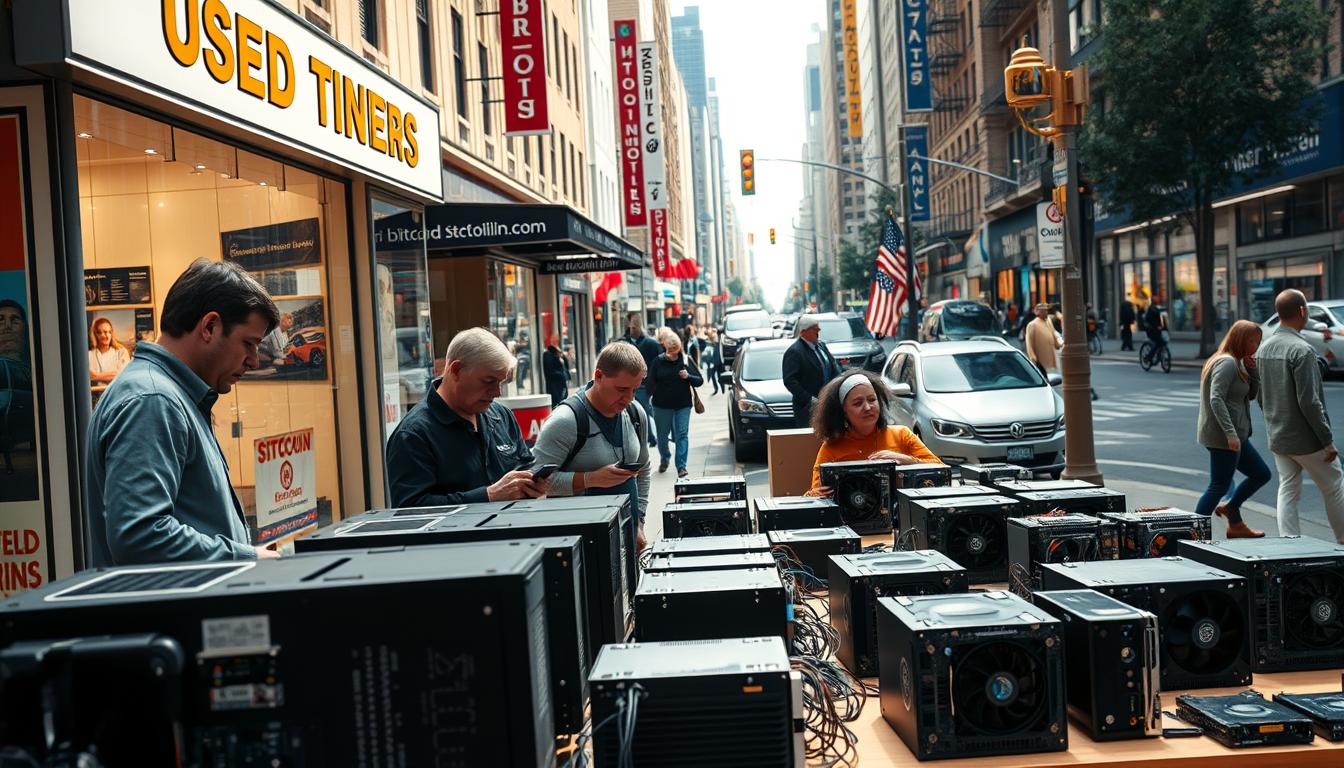

Surprising fact: as of 2024 there are over 70 U.S. hosting companies offering full service hosting — power, cooling, security, and often in-house repair.
I write this from hands‑on experience. I search the same phrases you do, but I focus on numbers that matter: energy cost, uptime, and proven returns.
Quick snapshot: at $0.06/kWh an S19j Pro pulls about $1.22/day while an S21 Pro class can hit ~$7.80/day. That math decides whether to self‑run, colocate, or walk away.
This intro gives a clear overview of the U.S. market, current prices, and practical options today. I’ll show tools, an inspection checklist, and a simple decision path so you can act with evidence, not hype.
Key Takeaways
- 70+ U.S. hosting firms change the value of local pickup vs. hosted colo.
- Energy price and efficiency drive daily returns; check kWh and J/TH.
- At $0.06/kWh, older S19 models can still be viable; S21 class yields are higher.
- Use a checklist: thermals, hashboards, firmware, and a pool test before any deal.
- I’ll map tools and a workflow to vet gear and compare hosting cost and risk.
Commercial intent decoded: how people buy used bitcoin miners near me today
Over the past seasons I mapped seller channels, hosting offers, and the real costs behind each route. That work shows two clear tracks for anyone evaluating equipment with commercial intent.
Local pickup vs. hosted deployment in the United States
Local pickup wins on speed and hands‑on inspection. I can verify fan noise, smell for burnt components, and power up a unit before money changes hands.
Hosted deployment wins on stability. Hosting providers handle power, cooling, security, and repairs. Big firms like Blockware, Simple Mining, and EZ Blockchain offer dashboards, repair options, and negotiated electricity rates.
What “near me” means in a nationwide market
“Near” often equals cheaper electrons. In the U.S., Texas and Georgia corridors frequently undercut local utilities once you factor in uptime and heat management.
Quick comparison
| Feature | Local Pickup | Hosted Colocation | Hybrid (Test then Host) |
|---|---|---|---|
| Speed to operate | Same day | Days–weeks | Same day test, then days |
| Inspection | Full hands‑on | Remote, vendor proof | Hands‑on + host verification |
| Electricity / energy | Home rates apply | Negotiated all‑in | Host rates after test |
| Hidden cost risk | Shipping & cooling | Deposits, setup fees | Mix of both |
My rule of thumb: if your total-in electricity is >$0.02/kWh above a host’s all-in, hosted typically nets better returns for small mining operations. Test one unit locally, then scale to a host to reduce handling risk and improve uptime.
Fast overview of today’s options and prices for used ASICs
I track live listings and fleet sales to see where real value hides in the second‑hand market. That quick scan reveals clear clusters by TH/s and efficiency that guide bidding and offers.
Where prices cluster by TH/s and efficiency
Performance bands: ~100 TH/s units (S19j Pro, M30S++) sit as budget workhorses. The ~120 TH/s S19k Pro is the efficiency sweet spot. Newer 170–234 TH/s rigs (S21 Pro, M60S, A1566) carry higher buy‑ins but much better returns.
- Profit at $0.06/kWh: S19j Pro ~100 TH/s ≈ $1.22/day; S19k Pro 120 TH/s ≈ $2.59/day.
- Higher tiers: S21 Pro 234 TH/s ≈ $7.80/day; M60S 170–186 TH/s ≈ $5.22/day; A1566 185 TH/s ≈ $4.82/day.
- Practical rules: efficiency (J/TH) beats raw TH/s when difficulty rises. Expect premiums for cleaner hashboards, low runtime, and firm warranty traces.
Tools and tactics: use an ASIC directory and RFQ marketplaces to triangulate fair price per TH and factor shipping and PSU swaps. Split listings into “plug‑and‑hash today” vs “needs TLC” before you bid.
Product roundup: best used bitcoin miners to target in 2025
Field tests and daily profit checks cut through the listings to surface the best candidates for 2025.
Bitmain Antminer S19j Pro — 100 TH/s, ~29.5 J/TH, ~2950W. At $0.06/per kwh it nets about $1.22/day. I mark this as a workhorse: parts are common and third‑party firmware makes tuning simpler.
Bitmain Antminer S19k Pro — 120 TH/s, ~23 J/TH, ~2760W. Around $2.59/day at $0.06/per kwh. This one stays competitive longer because of its better efficiency.
MicroBT Whatsminer M30S++ — 100–112 TH/s, ~3400W. Roughly $1.13/day at $0.06/per kwh. Solid, but higher power consumption and more maintenance risk versus S19 class.
S21 Pro and M60S availability — S21 Pro (234 TH/s, 15 J/TH) and M60S (170–186 TH/s, 18.5 J/TH) lead on raw profitability but supply in the secondary market is thin. Expect sticky prices and limited inventory.
| Model | TH/s | J/TH | Approx W | Est $/day @ $0.06 |
|---|---|---|---|---|
| S19j Pro | 100 | 29.5 | 2950 | $1.22 |
| S19k Pro | 120 | 23 | 2760 | $2.59 |
| M30S++ | 100–112 | ~34 | 3400 | $1.13 |
| S21 Pro | 234 | 15 | 3510 | $7.80 |
- I avoid mystery-condition listings; ask for pool screenshots and serial photos.
- Run a per-kwh sensitivity: ±$0.01 changes profitability fast.
- If firmware matters, confirm LuxOS or equivalent support before purchase.
Where to source used miners near you
Finding reliable channels for second‑hand ASICs takes more than scrolling listings. You want tools, proof, and a handle on total cost. Below I map the practical options I use when sourcing hardware for small operations.
Secondary markets and RFQ marketplaces
RFQs are my first stop for price discovery and fraud control. Post a request, compare offers, and demand onscreen evidence. Luxor’s marketplace and vetted Discord groups help pressure-test sellers.
Local dealers, meetups, and surplus resellers
Local pickups let you inspect noise, smell, and thermal behavior. I bring a flashlight and a thermal camera. Surplus lots can yield bargains — assume a 10–20% repair rate and price that into your offer.
Hosting companies that also sell hardware
Many U.S. hosts sell rigs and will rack them for you. Blockware Solutions, Simple Mining, and EZ Blockchain offer deployment, monitoring tools, and repair pipelines. Ask for a 24–72 hour burn‑in and pool screenshots before final payment.
- Rule: always calculate landed cost — unit + shipping + taxes + intake fees.
- Red flag: sellers who won’t show cold start to hash videos.
- Tip: keep a seller notebook for future deals and RMAs.
Evidence-backed vendors and hosting providers in the U.S. market
I keep a live roster of U.S. hosts and update it when firms add colo slots or change pricing. That practice lets me verify claims with numbers, contracts, and client references.
Who shows up in my tracking sheet
Fact: 70+ U.S. firms now offer colocation with power, cooling, security, and network stacks tuned for bitcoin mining.
Names I see repeatedly: Blockware Solutions, Compass Mining, Simple Mining, MiningStore, Giga Energy, Rebel Mining Company, and EZ Blockchain. The list also includes smaller regional hosts and several mining companies that resell capacity.
Featured example: EZ Blockchain
EZ Blockchain operates owned U.S. facilities with advertised all‑in energy from $0.069 per kwh. They assist with selection, configuration, and provide a management app. Their model leans on renewables and waste‑energy capture, which matters for ESG and large-scale professional mining buyers.
- I always ask hosts for PUE, MSA terms, intake fees, minimum term, SLA and curtailment policy.
- Look for real-time dashboards, spares inventory, and partner repair centers.
- Maintain redundancy: two hosts reduced downtime for me on two separate occasions.
Statistics you should know before you buy
Start with the math: daily returns and real power draw decide most deals.
Daily profitability profiles at $0.06/kWh
I normalize every model to $0.06 per kWh so comparisons stay apples‑to‑apples.
| Model | TH/s | J/TH | Power (W) | Est $/day @ $0.06 |
|---|---|---|---|---|
| Antminer S19j Pro | ~100 | 29.5 | 2950 | $1.22 |
| Bitmain Antminer S19k Pro | 120 | 23 | 2760 | $2.59 |
| Whatsminer M30S++ | 100–112 | ~34 | ~3400 | $1.13 |
| Antminer S21 Pro | 234 | 15 | 3510 | $7.80 |
| Whatsminer M60S | 170–186 | 18.5 | ~3150 | $5.22 |
Hashrate, efficiency, and power consumption benchmarks
Quick rules I use:
- Baseline: run sensitivity at $0.05 and $0.07 per kWh to see margin swings.
- Efficiency matters: J/TH predicts how well a unit survives rising difficulty.
- Power consumption: measure at the wall — specs understate real draw when gear is dusty or hot.
- Availability: S21 Pro class looks great on paper, but supply is thin versus S19 variants.
- Practical tip: include repair and downtime days in your ROI; a few lost days erase small advantages.
Pool variance and difficulty shifts change daily snapshots. I verify profitability over a week and check pool-side data, not just the local dashboard.
Graph: projecting hashprice and difficulty impacts on used-miner ROI
I built a forecast that overlays network difficulty, hashprice, and model break-even timelines. The visual shows when a rig’s daily return drops below operating cost and how long it stays net-positive under different scenarios.
Plot idea and evidence
What I plot: two trend lines—network difficulty and hashprice—plus break-even curves for S19j Pro, S19k Pro, and an S21-class rig. I add an electricity band so a $0.01/kWh swing visibly shifts ROI timelines.
- Efficiency wins: 15–23 J/TH machines keep payback curves flatter as difficulty rises, preserving profitability longer than ~29.5 J/TH gear.
- Real costs: include maintenance (fan/PSU swaps) and a 3–5% downtime band for curtailment to reflect true operations cashflow.
- Hosted vs home: plot hosted at ~$0.069/kWh against a $0.10/kWh garage; hosted often outperforms after fees.
- Actionable: annotate each curve with model snapshots (TH/s, J/TH, est $/day) so you can test buying thresholds against the forecast.
Prediction: late‑2024 trends favor efficiency-optimized machines into 2025. Save the chart template and refresh quarterly with updated difficulty and energy rates to keep decisions evidence-based.
Tools to evaluate a used miner’s value
When screening rigs I lean on three pillars: verified specs, price sensitivity, and live pool data. These steps cut risk and help me decide fast.
ASIC directory, RFQ marketplaces, and firmware resources
Start with an ASIC directory for specs and payback math. It filters out inefficient listings before you engage sellers.
RFQ marketplaces let you request exact models and condition grades. They surface S19j Pro, S19k Pro, and M30S++ offers and let you compare recent per‑TH sales.
Firmware and software matter. LuxOS supports S19j Pro and S19k Pro and gives tuning levers based on your electricity rate.
Electricity calculators and per‑kWh sensitivity checks
Run an electricity calculator with your real $/kWh and fees. Then test ±$0.01 per kWh to see margin swings.
Pool dashboards and monitoring apps for verification
Use pool dashboards to verify hashrate stability and HW errors over 24–72 hours. Host monitoring apps help, but always cross‑check pool‑side data.
| Tool | Purpose | Quick check |
|---|---|---|
| ASIC directory | Spec & payback screening | Compare J/TH, TH/s, and est $/day |
| RFQ marketplace | Price discovery & condition proof | Request serials, pool screenshots |
| Electricity calculator | Per‑kWh sensitivity | Run baseline +/‑ $0.01 scenarios |
| Pool dashboard | Live verification | Check hashrate consistency & HW errors |
- Track fan RPM and PSU rails; noisy patterns often predict failures.
- Set a $/TH ceiling per model and document each unit’s serial and test results for future resale.
Guide: on-site inspection checklist for used ASICs
Bring a test plan and a small toolkit; a few minutes of checks reveal most fatal flaws. I walk sellers through the same steps every time. That routine keeps decisions evidence-driven and fast.
Visual, thermal, and acoustic checks
Look for corrosion, soot, bent heatsinks, cracked connectors, and missing serial stickers. Any of these are red flags for water or rough handling.
Use a handheld IR thermometer. Hotspots on one hashboard often mean dead chips or failed thermal pads.
Listen closely. Bearing grind or fan wobble signals imminent failure. I won’t accept noisy units unless the price covers fan replacements.
Hashboard, PSU, and fan health verification
Run a short test and check detected chips per board. Intermittent detection usually points to ribbon cables or board faults that cost time and money to fix.
Measure voltage under load. Sagging rails show as hashrate dips and HW errors. Rule of thumb: budget one spare PSU per ten units.
Firmware status, uptime logs, and pool test
Confirm firmware and version. S19j Pro and S19k Pro support LuxOS for tuning; M30S++ often lacks third-party options. That difference affects your efficiency and software plan.
Ask for 24‑hour uptime screenshots showing stable hashrate, temps, and fan RPMs. Short bursts don’t prove sustained operations.
Insist on pool-side verification. Compare accepted shares and HW error counts on the pool dashboard, not just the unit’s local UI.
| Check | What to look for | Quick pass/fail | Evidence to collect |
|---|---|---|---|
| Visual | Corrosion, soot, missing labels | Pass = clean; Fail = suspect | Photos of heatsinks, serials |
| Thermal & Acoustic | Hotspots, grinding fans | Pass = even temps, quiet | IR readings, short audio/video |
| Firmware & Pool | Version, LuxOS support, shares | Pass = stable + pool confirms | Firmware screenshot, pool dashboard 24h |
Final notes: measure power draw at the wall when possible. Dust and old PSUs push energy and cost up, and that crushes margins fast. Get a bill of sale and any repair notes; clean paperwork improves resale value if you rotate inventory.
Power, efficiency, and per-kWh math that make or break profitability
A few watts here and a few J/TH there decide whether a rig stays or goes. I treat energy math as the primary filter when evaluating any unit for deployment.
J/TH vs. $/TH trade-offs on used gear
Simple rules: lower J/TH equals longer survivability as difficulty rises. For context: S19j Pro ≈ 29.5 J/TH (~$1.22/day @ $0.06), S19k Pro ≈ 23 J/TH (~$2.59/day), and S21 Pro ≈ 15 J/TH (~$7.80/day).
Do the per-kWh math with your actual host rate. I run scenarios at 5.5¢, 6.0¢, and 6.9¢ per kWh to see when older gear flips negative.
- I treat J/TH as a survivability score; lower is better.
- $ / TH is an entry sanity check — cheap TH/s with high consumption can lose to a pricier, efficient unit.
- Factor PUE and ambient derate — hot rooms raise fan load and hurt energy efficiency.
- Firmware underclocking can help; prefer cool, stable rigs over hot, brittle ones.
- Normalize listings by net profit per watt and include repair cadence as invisible cost.
In short: revenue follows hashrate, but watts and consumption decide whether you keep the margins. Do the math first, then chase hashrate. This approach saved me from several bad crypto mining buys and helps prioritize the right bitcoin miner for the site.
Hosting vs. self-run: cost, control, and risk trade-offs
When operations scale past a handful of units, the economics and risk profile change fast. You must weigh capital outlay against ongoing fees and who answers the midnight ticket.
Capex and opex
Upfront hardware cost is similar either way. Where things diverge is operating expense. Residential electricity and cooling raise your variable cost. Hosts quote an all‑in or per‑kWh fee—EZ Blockchain advertises retail support from $0.069/kWh as an example.
Downtime and repairs
At home, you are the on‑call tech. At a host, SLAs and ticket queues set restoration time. Hosts often include spare‑parts logistics and partner repairs that reduce mean time to repair.
Regulatory exposure
High‑density setups draw attention. A local permit issue can shut a private site. Hosting firms and mining companies absorb much of that risk but may include curtailment clauses in their MSA. Read contracts closely.
Hybrid paths: hosted purchase now, migrate later
A practical path: rack newly acquired rigs with a host for intake testing and burn‑in. That filters lemons and starts cash flow fast.
- Start hosted: collect 30–90 days of performance data before any migration decision.
- Compare real bills: total invoiced kWh at the host vs your utility, including demand charges.
- Scale choice: hosting accelerates growth; self-run gives ultimate control for immersion or firmware experiments.
“Data before pride — I often start hosted, gather evidence, then decide if a self‑run pilot pencils out.”
In a shifting market, an evidence‑first hybrid reduces risk. Use hosting intake tests as your quality gate, then move only when lower energy and regulatory clarity justify the switch.
Publicly traded miners as alternative exposure
Watching the listed miners tells you how large-scale hashrate and power contracts are shaping returns. If you want exposure without running machines, equities in this sector give liquidity and transparency.
I track headline EH/s and note which firms run hybrid models versus pure self-mining. Public companies report EH/s, power deals, and capex plans—use those to benchmark your site economics.
Top names, hashrate share, and market positioning
Quick evidence: Marathon (~29.9 EH/s), Core Scientific (~20.4 EH/s), CleanSpark (~17.3 EH/s), Riot (~12.6 EH/s), Iris Energy (~9.4 EH/s).
| Company | Reported EH/s | Model / Strategy | Key risk or edge |
|---|---|---|---|
| Marathon Digital (MARA) | ~29.9 EH/s | Self-mining, large fleet | Scale advantage; energy contract sensitivity |
| Core Scientific (CORZ) | ~20.4 EH/s | Hybrid hosting + self-mine | Execution risk and balance sheet focus |
| CleanSpark (CLSK) | ~17.3 EH/s | Self-mining + software services | Operational margins tied to power prices |
| Riot Platforms (RIOT) | ~12.6 EH/s | Large-scale U.S. facilities | Geographic power contracts are critical |
| Iris Energy, Bitdeer, others | ~9.4, 8.7 EH/s, etc. | Mixed: hosting, cloud mining offers | Diverse models; watch dilution and contracts |
My take: listed miners track the market and surface operational problems faster than rumors. I use their reports to sanity-check my power costs and efficiency targets.
- Practical note: stocks reflect sentiment and execution risk, not raw hash ownership.
- Benchmarking: if a miner’s cost-per-BTC drops materially, investigate their energy or immersion gains before upgrading your fleet.
buy used bitcoin miners near me: U.S. regional pathways
Regional hubs shape how I move gear, balance freight, and pick hosting partners. In the U.S., corridors matter more than a single listing when you value uptime and quick repairs.
Texas and Georgia colocation corridors
Texas offers large facilities and demand‑response programs. You can secure low rates, but know how hosts credit curtailment and handle peak events.
Georgia delivers grid reliability and many mid‑size hosts. Intake times are often faster and contracts tend to be retail‑friendly for small operations.
Local meetups and repair centers to extend asset life
Regional meetups and repair shops keep fleets running longer. A reliable board‑level shop and local spare parts reduce downtime and shipping damage risk.
- I map sellers, hosts, and repair centers within a two‑day shipping triangle to cut freight delays.
- Dust and heat raise maintenance; schedule filters and cleaning cycles by climate.
- Negotiate intake testing and basic remediation with hosts to catch lemons early.
“Ship into a hub with repair access and you trade a risky overnight save for steady operations and faster ROI.”
Tip: ask hosts about hedging and pass‑through clauses—state policy can flip electricity economics fast.
Predictions for 2025: used-market flow, prices, and difficulty
Expect clear inventory pulses as large fleets refresh into S21-class and similar hardware. Those waves will shape price windows and negotiating power for small operators.
Post-upgrade selling cycles and inventory waves
I expect supply to arrive in bursts when public and private mining companies report new deployments or excess stock. Follow procurement filings of publicly traded firms — they telegraph when bulk resale could hit the market.
Prices often lag fundamentals. Sellers anchor to past $/TH, buyers anchor to current hashprice. Be patient: disciplined bids during dips usually yield the best options.
Efficiency floors that remain competitive
Evidence-based rule: machines near 23 J/TH (S19k Pro class) look like the long-lived efficiency floor at mid-single-cent power. S21-class rigs at ~15 J/TH will hold profitability longer as difficulty rises.
Older 29–30 J/TH gear survives only with very low energy cost, smart underclocking, or aggressive maintenance. I model conservative payback cases first; if a unit fails under tougher assumptions, I pass.
- Short-term: S21-class secondhand flow stays thin until fleets finish ramping and debugging.
- Mid-term: expect wavey inventory and price lag — time purchases to market dips and verify pool-side performance.
- Bottom line: prioritize efficiency and clean test data; 2025 rewards discipline, not impulse.
Sources and proof of claims
You can trace most good claims back to three sources: host invoices, pool dashboards, and manufacturer specs. I used those pillars to compile the numbers and examples in this guide.
Hosting landscape and energy examples
Fact: 70+ U.S. hosting providers offer colocation with managed power, cooling, security, and dashboards. Many also resell hardware and run repair partnerships.
EZ Blockchain is a concrete example: owned U.S. sites, all-in energy from $0.069/kWh, renewables and a management app that aids deployment decisions.
ASIC specs, profitability, and verification
I cross-checked model specs to pool-side hashrate and profitability calculators at $0.06/kWh. Results: S19j Pro ≈ $1.22/day, S19k Pro ≈ $2.59/day, S21 Pro ≈ $7.80/day, plus immersion and high‑TH models listed earlier.
| Entity | Reported EH/s | Note |
|---|---|---|
| Marathon (MARA) | 29.9 | Large self‑mine fleet |
| Core Scientific (CORZ) | 20.4 | Hybrid hosting |
| CleanSpark (CLSK) | 17.3 | Operational margins tied to energy |
| Riot (RIOT) | 12.6 | Scale-based contracts |
| Iris Energy (IREN) | 9.4 | Renewables focus |
“Cross-check seller claims against pool logs and host invoices — numbers don’t lie.”
Conclusion
Concrete numbers beat hype when you choose gear today for bitcoin mining. Test an entry rig, run a burn‑in, and put real per‑kWh math against a tougher difficulty path before committing.
Quick checklist: prioritize energy and efficiency, verify pool logs, use the ASIC directory and RFQ tools, and benchmark hosting at ~ $0.069/kWh if home power or noise is a problem.
Old‑gen winners like the S19k Pro can survive with conservative assumptions. Newer rigs lift profitability but inventory timing matters. If a unit still looks good after a $0.01/kWh stress test and harder difficulty, it moves up my list. For hands‑off exposure, public miners are an option — but that buys equity, not direct hash. Stay patient, skeptical, and math‑driven. All claims here are source‑backed; use Section 16 to audit details.
FAQ
What should I check first when considering used ASIC hardware?
How do I compare energy efficiency across models?
Which used models still make sense in 2025 for smaller operators?
FAQ
What should I check first when considering used ASIC hardware?
Start with serial numbers, firmware version, and uptime logs. Verify model specs (hashrate and power consumption) against manufacturer sheets for Antminer and Whatsminer models. Inspect for physical damage, corrosion, and replaced fan assemblies. Ask for a short live mining test to confirm hashrate and stability before any transaction.
How do I compare energy efficiency across models?
Use joules per terahash (J/TH) as the primary metric. Lower J/TH means better efficiency. Then calculate $/TH by multiplying power draw by your electricity rate (per kWh). Factor in real-world inefficiencies: older PSUs, degraded hashboards, and cooling losses raise effective J/TH on used units.
Which used models still make sense in 2025 for smaller operators?
Look for late-generation S19j Pro and S19k Pro models and MicroBT Whatsminer M30S++ where available. They balance decent TH/s with reasonable efficiency. Newer S21 and M60S are often scarce on secondary markets, so older high-efficiency S19k Pro units can outcompete cheaper, less efficient miners when electricity costs exceed ~
FAQ
What should I check first when considering used ASIC hardware?
Start with serial numbers, firmware version, and uptime logs. Verify model specs (hashrate and power consumption) against manufacturer sheets for Antminer and Whatsminer models. Inspect for physical damage, corrosion, and replaced fan assemblies. Ask for a short live mining test to confirm hashrate and stability before any transaction.
How do I compare energy efficiency across models?
Use joules per terahash (J/TH) as the primary metric. Lower J/TH means better efficiency. Then calculate $/TH by multiplying power draw by your electricity rate (per kWh). Factor in real-world inefficiencies: older PSUs, degraded hashboards, and cooling losses raise effective J/TH on used units.
Which used models still make sense in 2025 for smaller operators?
Look for late-generation S19j Pro and S19k Pro models and MicroBT Whatsminer M30S++ where available. They balance decent TH/s with reasonable efficiency. Newer S21 and M60S are often scarce on secondary markets, so older high-efficiency S19k Pro units can outcompete cheaper, less efficient miners when electricity costs exceed ~$0.05–0.07/kWh.
Is local pickup better than hosted deployment?
It depends. Local pickup gives full control and avoids hosting fees, but you need proper electrical infrastructure, cooling, and redundancy. Hosted deployment reduces operational headaches—colocation handles power, networking, and cooling—at the cost of ongoing fees and less direct control. For many, hybrid approaches (host now, migrate later) are practical.
How much does electricity affect used-miner profitability?
Dramatically. At the same hashrate, a 5–10 J/TH difference can change daily profit by tens of dollars at typical hashprice/difficulty levels. Always run per-kWh sensitivity checks: profit = (coin revenue per day) – (power draw kW * 24 * electricity rate). Use conservative hashprice and difficulty scenarios.
Where do reputable secondary-market miners come from?
Sources include RFQ marketplaces, surplus resellers, hosting companies selling retired capacity, and enterprise liquidations. In the U.S., many hosting providers sell decommissioned rigs with known histories. Avoid anonymous listings without verifiable provenance or shipping history.
What documentation or proof should sellers provide?
Request proof of operation (pool payout logs), serial numbers, invoice of original purchase if available, and photos/videos of the unit running under load. For hosted-to-owner sales, ask for maintenance records and any warranty or return policies the hosting firm offers.
How do I verify real-world hashrate from a used miner?
Prefer a live on-site test mining to a trusted pool or use a seller-provided mining session with timestamps. Cross-check reported hashrate on pool dashboards and examine chip-level error rates and rejected share counts. High HW error rates can indicate degraded hashboards or firmware problems.
What role does firmware play in used ASIC performance?
Firmware affects stability, fan curves, and sometimes hashrate. Ensure firmware is authentic and up to date for the model. Custom firmware can improve performance but may void warranties and complicate future diagnostics. Retain stock firmware unless you know the vendor and risks well.
Are warranties common on secondary-market miners?
Rare. Most used units sell as-is. Some hosting companies or resellers offer short limited warranties or return windows. Always clarify terms, and price in the risk of immediate repairs or parts replacement when calculating ROI.
How should I inspect a miner on-site? Checklist?
Visual: check for dents, excessive dust, and replaced connectors. Thermal: feel for hot spots during a short run; cooling should be even. Acoustic: listen for abnormal bearings or rattling fans. Electrical: verify power draw with a meter. Firmware and pool: confirm uptime logs and stable shares. Take photos and record serials.
What are common repair costs for used ASICs?
Fan replacement, PSUs, and hashboard repairs are most common. Fans are inexpensive; PSUs and hashboards are costlier and may require skilled techs. Budget a repair reserve—often several hundred dollars per rig depending on model age and condition.
How do hosting fees compare to self-running costs?
Hosting fees bundle power, cooling, internet, security, and support. Typical colocation rates vary widely—some U.S. providers advertise rates around $0.06–0.08/kWh equivalent depending on contract and scale. Self-running moves costs into capex (power infrastructure) and opex (maintenance, downtime). Calculate total cost per TH including amortization of the miner.
Can I use pool dashboards to confirm a seller’s claims?
Yes. Well-managed pools show miner IDs, reported hashrate, and share history. Ask the seller for a miner ID and check the pool’s public dashboard. Look for consistent payouts and low stale/reject rates. Sudden drops or inconsistent reporting are red flags.
How does network difficulty and hashprice influence used-miner ROI?
Higher difficulty and lower hashprice reduce daily revenue, lengthening payback. Used miners have less runway, so model age and efficiency matter more when difficulty trends upward. Run scenario analyses: best, base, and stressed difficulty/hashprice cases to estimate break-even timelines.
Are there regional differences in the U.S. I should consider?
Yes. Texas and Georgia are major colocation corridors with abundant capacity and competitive rates. Electricity sourcing, local permitting, and grid reliability vary by state and can change hosting cost assumptions. Local repair centers and meetups also affect serviceability and parts availability.
What tools help value a used miner quickly?
Use ASIC spec directories, RFQ marketplace listings for current price bands, electricity rate calculators, and profitability calculators that accept custom J/TH and power draw. Pool dashboards and monitoring apps help verify performance claims in real time.
Should I consider publicly traded mining companies instead of owning hardware?
If you prefer exposure without operational complexity, publicly traded miners (e.g., Marathon Digital, Riot Platforms) offer a liquidity route. They trade company-level risk and management execution rather than individual hardware ownership. Evaluate balance sheets, hashrate growth, and energy strategy.
How scarce are S21/S21 Pro and newer Whatsminer M60S units on secondary markets?
Scarcity is increasing. Many S21 and M60S units are retained by large-scale operations or sold via controlled channels, reducing open-market availability. That raises prices and makes older high-efficiency models like S19k Pro more attractive for buyers focused on predictable ROI.
Any final practical tips before making an offer?
Verify provenance, demand a live test, budget for repairs, and run conservative profitability scenarios. Prioritize units with documented uptime and low HW error counts. If you’re uncertain, consult a local repair shop or hosting partner before closing a deal.
FAQ
What should I check first when considering used ASIC hardware?
Start with serial numbers, firmware version, and uptime logs. Verify model specs (hashrate and power consumption) against manufacturer sheets for Antminer and Whatsminer models. Inspect for physical damage, corrosion, and replaced fan assemblies. Ask for a short live mining test to confirm hashrate and stability before any transaction.
How do I compare energy efficiency across models?
Use joules per terahash (J/TH) as the primary metric. Lower J/TH means better efficiency. Then calculate $/TH by multiplying power draw by your electricity rate (per kWh). Factor in real-world inefficiencies: older PSUs, degraded hashboards, and cooling losses raise effective J/TH on used units.
Which used models still make sense in 2025 for smaller operators?
Look for late-generation S19j Pro and S19k Pro models and MicroBT Whatsminer M30S++ where available. They balance decent TH/s with reasonable efficiency. Newer S21 and M60S are often scarce on secondary markets, so older high-efficiency S19k Pro units can outcompete cheaper, less efficient miners when electricity costs exceed ~
FAQ
What should I check first when considering used ASIC hardware?
Start with serial numbers, firmware version, and uptime logs. Verify model specs (hashrate and power consumption) against manufacturer sheets for Antminer and Whatsminer models. Inspect for physical damage, corrosion, and replaced fan assemblies. Ask for a short live mining test to confirm hashrate and stability before any transaction.
How do I compare energy efficiency across models?
Use joules per terahash (J/TH) as the primary metric. Lower J/TH means better efficiency. Then calculate $/TH by multiplying power draw by your electricity rate (per kWh). Factor in real-world inefficiencies: older PSUs, degraded hashboards, and cooling losses raise effective J/TH on used units.
Which used models still make sense in 2025 for smaller operators?
Look for late-generation S19j Pro and S19k Pro models and MicroBT Whatsminer M30S++ where available. They balance decent TH/s with reasonable efficiency. Newer S21 and M60S are often scarce on secondary markets, so older high-efficiency S19k Pro units can outcompete cheaper, less efficient miners when electricity costs exceed ~$0.05–0.07/kWh.
Is local pickup better than hosted deployment?
It depends. Local pickup gives full control and avoids hosting fees, but you need proper electrical infrastructure, cooling, and redundancy. Hosted deployment reduces operational headaches—colocation handles power, networking, and cooling—at the cost of ongoing fees and less direct control. For many, hybrid approaches (host now, migrate later) are practical.
How much does electricity affect used-miner profitability?
Dramatically. At the same hashrate, a 5–10 J/TH difference can change daily profit by tens of dollars at typical hashprice/difficulty levels. Always run per-kWh sensitivity checks: profit = (coin revenue per day) – (power draw kW * 24 * electricity rate). Use conservative hashprice and difficulty scenarios.
Where do reputable secondary-market miners come from?
Sources include RFQ marketplaces, surplus resellers, hosting companies selling retired capacity, and enterprise liquidations. In the U.S., many hosting providers sell decommissioned rigs with known histories. Avoid anonymous listings without verifiable provenance or shipping history.
What documentation or proof should sellers provide?
Request proof of operation (pool payout logs), serial numbers, invoice of original purchase if available, and photos/videos of the unit running under load. For hosted-to-owner sales, ask for maintenance records and any warranty or return policies the hosting firm offers.
How do I verify real-world hashrate from a used miner?
Prefer a live on-site test mining to a trusted pool or use a seller-provided mining session with timestamps. Cross-check reported hashrate on pool dashboards and examine chip-level error rates and rejected share counts. High HW error rates can indicate degraded hashboards or firmware problems.
What role does firmware play in used ASIC performance?
Firmware affects stability, fan curves, and sometimes hashrate. Ensure firmware is authentic and up to date for the model. Custom firmware can improve performance but may void warranties and complicate future diagnostics. Retain stock firmware unless you know the vendor and risks well.
Are warranties common on secondary-market miners?
Rare. Most used units sell as-is. Some hosting companies or resellers offer short limited warranties or return windows. Always clarify terms, and price in the risk of immediate repairs or parts replacement when calculating ROI.
How should I inspect a miner on-site? Checklist?
Visual: check for dents, excessive dust, and replaced connectors. Thermal: feel for hot spots during a short run; cooling should be even. Acoustic: listen for abnormal bearings or rattling fans. Electrical: verify power draw with a meter. Firmware and pool: confirm uptime logs and stable shares. Take photos and record serials.
What are common repair costs for used ASICs?
Fan replacement, PSUs, and hashboard repairs are most common. Fans are inexpensive; PSUs and hashboards are costlier and may require skilled techs. Budget a repair reserve—often several hundred dollars per rig depending on model age and condition.
How do hosting fees compare to self-running costs?
Hosting fees bundle power, cooling, internet, security, and support. Typical colocation rates vary widely—some U.S. providers advertise rates around $0.06–0.08/kWh equivalent depending on contract and scale. Self-running moves costs into capex (power infrastructure) and opex (maintenance, downtime). Calculate total cost per TH including amortization of the miner.
Can I use pool dashboards to confirm a seller’s claims?
Yes. Well-managed pools show miner IDs, reported hashrate, and share history. Ask the seller for a miner ID and check the pool’s public dashboard. Look for consistent payouts and low stale/reject rates. Sudden drops or inconsistent reporting are red flags.
How does network difficulty and hashprice influence used-miner ROI?
Higher difficulty and lower hashprice reduce daily revenue, lengthening payback. Used miners have less runway, so model age and efficiency matter more when difficulty trends upward. Run scenario analyses: best, base, and stressed difficulty/hashprice cases to estimate break-even timelines.
Are there regional differences in the U.S. I should consider?
Yes. Texas and Georgia are major colocation corridors with abundant capacity and competitive rates. Electricity sourcing, local permitting, and grid reliability vary by state and can change hosting cost assumptions. Local repair centers and meetups also affect serviceability and parts availability.
What tools help value a used miner quickly?
Use ASIC spec directories, RFQ marketplace listings for current price bands, electricity rate calculators, and profitability calculators that accept custom J/TH and power draw. Pool dashboards and monitoring apps help verify performance claims in real time.
Should I consider publicly traded mining companies instead of owning hardware?
If you prefer exposure without operational complexity, publicly traded miners (e.g., Marathon Digital, Riot Platforms) offer a liquidity route. They trade company-level risk and management execution rather than individual hardware ownership. Evaluate balance sheets, hashrate growth, and energy strategy.
How scarce are S21/S21 Pro and newer Whatsminer M60S units on secondary markets?
Scarcity is increasing. Many S21 and M60S units are retained by large-scale operations or sold via controlled channels, reducing open-market availability. That raises prices and makes older high-efficiency models like S19k Pro more attractive for buyers focused on predictable ROI.
Any final practical tips before making an offer?
Verify provenance, demand a live test, budget for repairs, and run conservative profitability scenarios. Prioritize units with documented uptime and low HW error counts. If you’re uncertain, consult a local repair shop or hosting partner before closing a deal.
.05–0.07/kWh.
Is local pickup better than hosted deployment?
It depends. Local pickup gives full control and avoids hosting fees, but you need proper electrical infrastructure, cooling, and redundancy. Hosted deployment reduces operational headaches—colocation handles power, networking, and cooling—at the cost of ongoing fees and less direct control. For many, hybrid approaches (host now, migrate later) are practical.
How much does electricity affect used-miner profitability?
Dramatically. At the same hashrate, a 5–10 J/TH difference can change daily profit by tens of dollars at typical hashprice/difficulty levels. Always run per-kWh sensitivity checks: profit = (coin revenue per day) – (power draw kW * 24 * electricity rate). Use conservative hashprice and difficulty scenarios.
Where do reputable secondary-market miners come from?
Sources include RFQ marketplaces, surplus resellers, hosting companies selling retired capacity, and enterprise liquidations. In the U.S., many hosting providers sell decommissioned rigs with known histories. Avoid anonymous listings without verifiable provenance or shipping history.
What documentation or proof should sellers provide?
Request proof of operation (pool payout logs), serial numbers, invoice of original purchase if available, and photos/videos of the unit running under load. For hosted-to-owner sales, ask for maintenance records and any warranty or return policies the hosting firm offers.
How do I verify real-world hashrate from a used miner?
Prefer a live on-site test mining to a trusted pool or use a seller-provided mining session with timestamps. Cross-check reported hashrate on pool dashboards and examine chip-level error rates and rejected share counts. High HW error rates can indicate degraded hashboards or firmware problems.
What role does firmware play in used ASIC performance?
Firmware affects stability, fan curves, and sometimes hashrate. Ensure firmware is authentic and up to date for the model. Custom firmware can improve performance but may void warranties and complicate future diagnostics. Retain stock firmware unless you know the vendor and risks well.
Are warranties common on secondary-market miners?
Rare. Most used units sell as-is. Some hosting companies or resellers offer short limited warranties or return windows. Always clarify terms, and price in the risk of immediate repairs or parts replacement when calculating ROI.
How should I inspect a miner on-site? Checklist?
Visual: check for dents, excessive dust, and replaced connectors. Thermal: feel for hot spots during a short run; cooling should be even. Acoustic: listen for abnormal bearings or rattling fans. Electrical: verify power draw with a meter. Firmware and pool: confirm uptime logs and stable shares. Take photos and record serials.
What are common repair costs for used ASICs?
Fan replacement, PSUs, and hashboard repairs are most common. Fans are inexpensive; PSUs and hashboards are costlier and may require skilled techs. Budget a repair reserve—often several hundred dollars per rig depending on model age and condition.
How do hosting fees compare to self-running costs?
Hosting fees bundle power, cooling, internet, security, and support. Typical colocation rates vary widely—some U.S. providers advertise rates around
FAQ
What should I check first when considering used ASIC hardware?
Start with serial numbers, firmware version, and uptime logs. Verify model specs (hashrate and power consumption) against manufacturer sheets for Antminer and Whatsminer models. Inspect for physical damage, corrosion, and replaced fan assemblies. Ask for a short live mining test to confirm hashrate and stability before any transaction.
How do I compare energy efficiency across models?
Use joules per terahash (J/TH) as the primary metric. Lower J/TH means better efficiency. Then calculate $/TH by multiplying power draw by your electricity rate (per kWh). Factor in real-world inefficiencies: older PSUs, degraded hashboards, and cooling losses raise effective J/TH on used units.
Which used models still make sense in 2025 for smaller operators?
Look for late-generation S19j Pro and S19k Pro models and MicroBT Whatsminer M30S++ where available. They balance decent TH/s with reasonable efficiency. Newer S21 and M60S are often scarce on secondary markets, so older high-efficiency S19k Pro units can outcompete cheaper, less efficient miners when electricity costs exceed ~$0.05–0.07/kWh.
Is local pickup better than hosted deployment?
It depends. Local pickup gives full control and avoids hosting fees, but you need proper electrical infrastructure, cooling, and redundancy. Hosted deployment reduces operational headaches—colocation handles power, networking, and cooling—at the cost of ongoing fees and less direct control. For many, hybrid approaches (host now, migrate later) are practical.
How much does electricity affect used-miner profitability?
Dramatically. At the same hashrate, a 5–10 J/TH difference can change daily profit by tens of dollars at typical hashprice/difficulty levels. Always run per-kWh sensitivity checks: profit = (coin revenue per day) – (power draw kW * 24 * electricity rate). Use conservative hashprice and difficulty scenarios.
Where do reputable secondary-market miners come from?
Sources include RFQ marketplaces, surplus resellers, hosting companies selling retired capacity, and enterprise liquidations. In the U.S., many hosting providers sell decommissioned rigs with known histories. Avoid anonymous listings without verifiable provenance or shipping history.
What documentation or proof should sellers provide?
Request proof of operation (pool payout logs), serial numbers, invoice of original purchase if available, and photos/videos of the unit running under load. For hosted-to-owner sales, ask for maintenance records and any warranty or return policies the hosting firm offers.
How do I verify real-world hashrate from a used miner?
Prefer a live on-site test mining to a trusted pool or use a seller-provided mining session with timestamps. Cross-check reported hashrate on pool dashboards and examine chip-level error rates and rejected share counts. High HW error rates can indicate degraded hashboards or firmware problems.
What role does firmware play in used ASIC performance?
Firmware affects stability, fan curves, and sometimes hashrate. Ensure firmware is authentic and up to date for the model. Custom firmware can improve performance but may void warranties and complicate future diagnostics. Retain stock firmware unless you know the vendor and risks well.
Are warranties common on secondary-market miners?
Rare. Most used units sell as-is. Some hosting companies or resellers offer short limited warranties or return windows. Always clarify terms, and price in the risk of immediate repairs or parts replacement when calculating ROI.
How should I inspect a miner on-site? Checklist?
Visual: check for dents, excessive dust, and replaced connectors. Thermal: feel for hot spots during a short run; cooling should be even. Acoustic: listen for abnormal bearings or rattling fans. Electrical: verify power draw with a meter. Firmware and pool: confirm uptime logs and stable shares. Take photos and record serials.
What are common repair costs for used ASICs?
Fan replacement, PSUs, and hashboard repairs are most common. Fans are inexpensive; PSUs and hashboards are costlier and may require skilled techs. Budget a repair reserve—often several hundred dollars per rig depending on model age and condition.
How do hosting fees compare to self-running costs?
Hosting fees bundle power, cooling, internet, security, and support. Typical colocation rates vary widely—some U.S. providers advertise rates around $0.06–0.08/kWh equivalent depending on contract and scale. Self-running moves costs into capex (power infrastructure) and opex (maintenance, downtime). Calculate total cost per TH including amortization of the miner.
Can I use pool dashboards to confirm a seller’s claims?
Yes. Well-managed pools show miner IDs, reported hashrate, and share history. Ask the seller for a miner ID and check the pool’s public dashboard. Look for consistent payouts and low stale/reject rates. Sudden drops or inconsistent reporting are red flags.
How does network difficulty and hashprice influence used-miner ROI?
Higher difficulty and lower hashprice reduce daily revenue, lengthening payback. Used miners have less runway, so model age and efficiency matter more when difficulty trends upward. Run scenario analyses: best, base, and stressed difficulty/hashprice cases to estimate break-even timelines.
Are there regional differences in the U.S. I should consider?
Yes. Texas and Georgia are major colocation corridors with abundant capacity and competitive rates. Electricity sourcing, local permitting, and grid reliability vary by state and can change hosting cost assumptions. Local repair centers and meetups also affect serviceability and parts availability.
What tools help value a used miner quickly?
Use ASIC spec directories, RFQ marketplace listings for current price bands, electricity rate calculators, and profitability calculators that accept custom J/TH and power draw. Pool dashboards and monitoring apps help verify performance claims in real time.
Should I consider publicly traded mining companies instead of owning hardware?
If you prefer exposure without operational complexity, publicly traded miners (e.g., Marathon Digital, Riot Platforms) offer a liquidity route. They trade company-level risk and management execution rather than individual hardware ownership. Evaluate balance sheets, hashrate growth, and energy strategy.
How scarce are S21/S21 Pro and newer Whatsminer M60S units on secondary markets?
Scarcity is increasing. Many S21 and M60S units are retained by large-scale operations or sold via controlled channels, reducing open-market availability. That raises prices and makes older high-efficiency models like S19k Pro more attractive for buyers focused on predictable ROI.
Any final practical tips before making an offer?
Verify provenance, demand a live test, budget for repairs, and run conservative profitability scenarios. Prioritize units with documented uptime and low HW error counts. If you’re uncertain, consult a local repair shop or hosting partner before closing a deal.
.06–0.08/kWh equivalent depending on contract and scale. Self-running moves costs into capex (power infrastructure) and opex (maintenance, downtime). Calculate total cost per TH including amortization of the miner.
Can I use pool dashboards to confirm a seller’s claims?
Yes. Well-managed pools show miner IDs, reported hashrate, and share history. Ask the seller for a miner ID and check the pool’s public dashboard. Look for consistent payouts and low stale/reject rates. Sudden drops or inconsistent reporting are red flags.
How does network difficulty and hashprice influence used-miner ROI?
Higher difficulty and lower hashprice reduce daily revenue, lengthening payback. Used miners have less runway, so model age and efficiency matter more when difficulty trends upward. Run scenario analyses: best, base, and stressed difficulty/hashprice cases to estimate break-even timelines.
Are there regional differences in the U.S. I should consider?
Yes. Texas and Georgia are major colocation corridors with abundant capacity and competitive rates. Electricity sourcing, local permitting, and grid reliability vary by state and can change hosting cost assumptions. Local repair centers and meetups also affect serviceability and parts availability.
What tools help value a used miner quickly?
Use ASIC spec directories, RFQ marketplace listings for current price bands, electricity rate calculators, and profitability calculators that accept custom J/TH and power draw. Pool dashboards and monitoring apps help verify performance claims in real time.
Should I consider publicly traded mining companies instead of owning hardware?
If you prefer exposure without operational complexity, publicly traded miners (e.g., Marathon Digital, Riot Platforms) offer a liquidity route. They trade company-level risk and management execution rather than individual hardware ownership. Evaluate balance sheets, hashrate growth, and energy strategy.
How scarce are S21/S21 Pro and newer Whatsminer M60S units on secondary markets?
Scarcity is increasing. Many S21 and M60S units are retained by large-scale operations or sold via controlled channels, reducing open-market availability. That raises prices and makes older high-efficiency models like S19k Pro more attractive for buyers focused on predictable ROI.
Any final practical tips before making an offer?
Verify provenance, demand a live test, budget for repairs, and run conservative profitability scenarios. Prioritize units with documented uptime and low HW error counts. If you’re uncertain, consult a local repair shop or hosting partner before closing a deal.

Safe Ethereum Purchase Guide 2025 – Best Platforms

Top Crypto Trading Platforms in 2025 Revealed

Top Layer-2 Scaling Solutions Compared

Top Secure Crypto Wallets for Beginners 2025

2025 Crypto Regulation Changes Explained for US Investors