
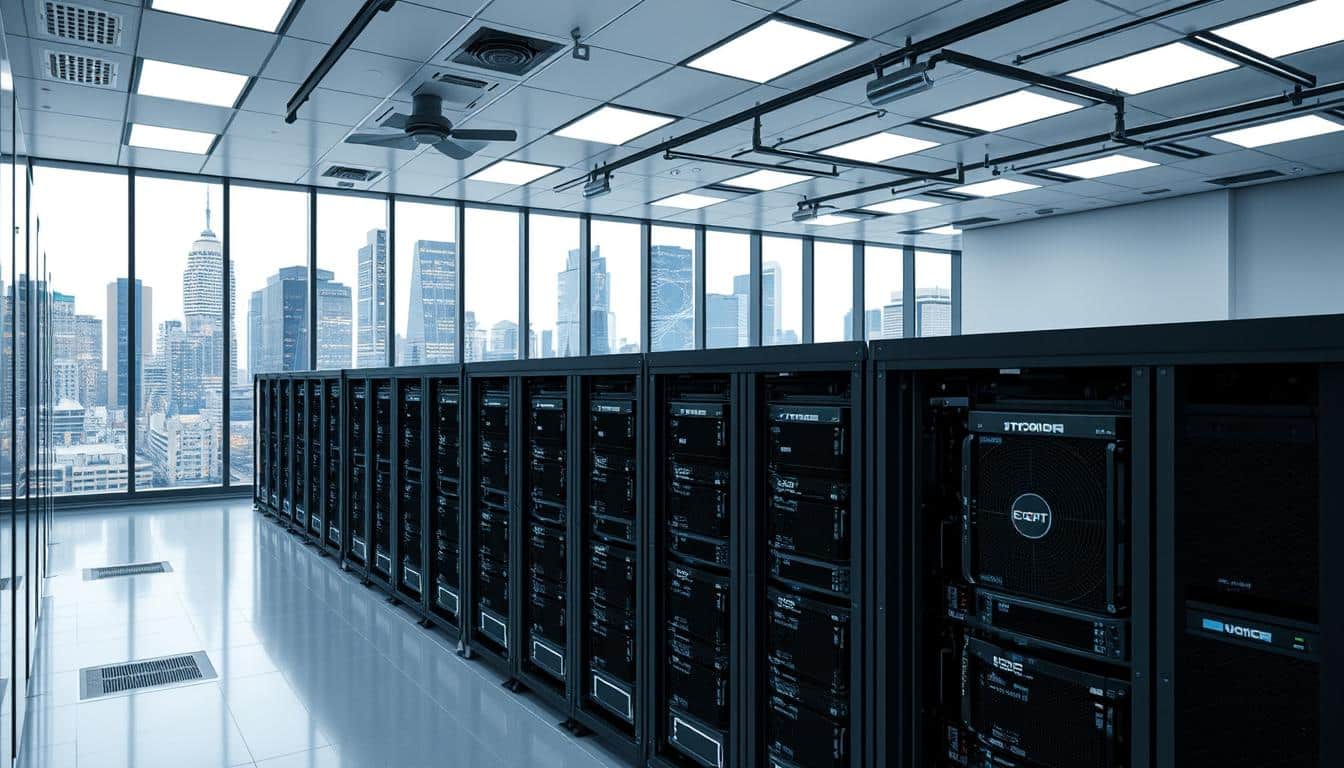

97% uptime is what one major operator advertises — and that single number tells you how tight margins get when energy, racks, and redundancy must all line up.
I wrote this guide to get straight about pricing, infrastructure, and the tools that matter in real-world operation. I’ll use current kWh figures (think $0.065–$0.085), reported uptime, and repair terms to cut through the marketing spin.
Energy pricing and stable delivery drive outcomes more than flashy dashboards. AI-driven optimization and real-time billing can move revenue too, but cents per kWh usually win.
Expect a clear walkthrough from consultation to install to ongoing reporting, plus side-by-side notes on facilities built for cold or heat and what actually protects uptime.
Key Takeaways
- Real kWh rates (around $0.065–$0.085) are the primary margin lever.
- Redundant fiber and 24/7 security correlate with better uptime.
- AI tools and dashboards help, but power reliability matters most.
- Look for clear repair terms and precision billing when choosing a service.
- This guide will give practical checks to pressure-test pricing and infrastructure.
Why businesses choose bitcoin mining hosting services today
Most executives ask one plain question: what’s the delivered kWh cost and how steady is the feed?
I run a simple graph for clients: the x‑axis is delivered power rates (¢/kWh), the y‑axis is projected daily revenue per TH/s after electricity. It shows plainly how each cent compresses margins.
Core stats matter: wind at source can be 2–4¢/kWh, yet commercial plans land at roughly $0.065–$0.085/kWh all‑in depending on location and tier.
Recent snapshots I track: South Carolina at $0.065/kWh, Iowa $0.07–$0.08/kWh, OneMiners global sites $0.052–$0.057/kWh, and EZ Blockchain all‑in at $0.075–$0.085/kWh with a $30 setup fee.
- Why it matters: a 1¢/kWh swing can change monthly revenue by hundreds to thousands on a mid‑sized fleet.
- Stable delivery, curtailment patterns, and grid relationships translate rates into real uptime and real earnings.
- My rule: at or below $0.07/kWh all‑in with solid uptime, you’re competitive; below $0.06/kWh globally, you’re top decile—verify power quality and terms.
| Location / Provider | Delivered kWh | Notes |
|---|---|---|
| Wind (source) | 2–4¢ | Lowest generation cost; not always deliverable to racks |
| South Carolina (OneMiners) | $0.065 | Competitive U.S. hosting rate |
| Iowa (Simple Mining) | $0.07–$0.08 | Transparent dashboards, common U.S. benchmark |
| EZ Blockchain (all‑in) | $0.075–$0.085 | Includes setup fee (~$30/unit) and O&M |
| Global low sites (OneMiners) | $0.052–$0.057 | Selective regions: Nigeria, Ethiopia, Dubai — verify network & security |
Evidence I trust: EZ Blockchain, OneMiners, and Simple Mining provide the market benchmarks I use to stress‑test models. Bottom line: lower kWh with reliable delivery wins.
Transparent pricing, electricity rates, and total cost of ownership
Let’s unpack what you actually pay — beyond the headline rate. I break total cost of ownership into four practical buckets so numbers mean something when you scale.
Four TCO buckets:
- Power: your true kWh rate and any curtailment or demand charges.
- Setup: one-off costs like the typical $30 per miner installation fee.
- Recurring O&M: cooling, network, routine equipment upkeep.
- Performance leakage: downtime, throttling, and repair lag that eats yield.
Real examples and evidence: EZ Blockchain lists all‑in rates at $0.075–$0.085/kWh plus a $30 setup per miner. OneMiners shows $0.065/kWh in South Carolina and Finland, with select global sites at $0.052–$0.057/kWh. Simple Mining runs Iowa at roughly $0.07–$0.08/kWh and can offer ~ $0.07/kWh on some plans.
“A low sticker kWh doesn’t guarantee low total cost — always ask for a sample monthly invoice.”
| Provider | Published kWh | Notes |
|---|---|---|
| EZ Blockchain | $0.075–$0.085 | All‑in rate; $30 setup per miner |
| OneMiners | $0.052–$0.065 | South Carolina/Finland at $0.065; select low‑cost global sites |
| Simple Mining | $0.07–$0.08 | Iowa benchmark; transparent dashboards |
Practical tip: always request a line‑item invoice and factor shipping, insurance, and commissioning into month one. At scale, installation cadence and repair SLA often trump a minor cents‑per‑kWh delta.
Infrastructure that safeguards uptime, performance, and security
Good infrastructure separates marketing from reality; I look for the basics that actually keep racks online.
Start with network and uptime. EZ Blockchain publishes 97% uptime backed by redundant high‑speed fiber and cable feeds. They couple that with robust network security and remote monitoring to limit packet loss and time‑to‑repair.
Uptime and network
Redundancy matters. Dual fiber paths, 24/7 recorded video, motion sensors, locking gates and a 7‑ft fence with razor wire all reduce physical risk and improve insurance terms.
Cooling and environment
All hardware sits in mobile data centers rated for -30°F to +100°F with airflow sensors. Tight airflow control prevents thermal throttling during extreme conditions.
Scalability & flexibility
Modular mobile data centers let you add capacity near power sources without a full site redesign. Watch breaker loading and network aggregation as density rises; the operator should publish airflow diagrams and delta‑T targets under full load.
Energy sources and sustainability
The energy mix shapes costs and resilience: wind can run 2–4¢/kWh, solar capacity is growing ~42% annually, and nuclear averages a 92.7% capacity factor. Facilities that blend sources tend to ride curtailments better.
- Documentation: Tier‑like procedures, change control, and ticketing predict steadier uptime.
- Support: A named onsite contact and SLA cuts time‑to‑repair when an ASIC needs attention.
“I don’t compromise on core infrastructure: published 97% uptime backed by redundant fiber and real network security separates real facilities from temporary sheds.”
For real examples and provider comparisons, see the regional analysis at Bitfarms and regional operators. Use those data points to pressure‑test facility claims before you commit capacity.
Tools that maximize mining results
Real results come from automation, fast repairs, and clean consumption data. I focus on tools that turn raw hash into steady receipts and fewer surprises.
AI-driven smart optimization
OneMiners’ Smart Mining claims it can “boost crypto mining revenue by 6-115%.” I treat that as a multiplier, not magic.
The biggest gains come from smarter power windows, tuned fan curves, and pool/payout tweaks that lift hashrate without extra watts.
Repairs, on-site support, and uptime
Simple Mining offers free repairs for 12 months through a top ASIC repair center. That matters.
EZ Blockchain adds 365-day onsite techs and routine cleaner cycles. A tech swapping a PSU in minutes beats an email ticket every time.
Precision billing and risk controls
Real-time dashboards must show hashrate, board temps, and alerts. Precision billing—pay-for-actual consumption—keeps P&L honest.
Pause periods are underrated; being able to suspend a fleet during volatility preserves capital and hash.
“If I can’t see the data, I can’t manage the fleet.”
For a quick cloud deal and promo, check this cloud offer that some operators use to trial optimization.
Getting started guide: From consultation to ongoing reporting
Getting started is simpler than it looks if you follow a clear, staged plan from first consult to steady reporting. I lay out a repeatable path I use with clients so you can verify outcomes at every step.
How it works: consultation, procurement, installation, configuration, and continuous monitoring
Step one: a short consult with the team to map goals, budget, and timelines. The experts help size equipment and forecast cash flows before you start mining.
Next we align procurement. Ship your miners or source equipment through vetted channels. Confirm serials, firmware, and warranty status before transit.
Installation and configuration are scripted at the data center: rack layout, network settings, pool configs, and baseline efficiency targets captured on day one.
I insist on remote access and alert thresholds so the operation surfaces issues fast. Expect a shakedown month while airflow and fan curves get tuned.
Reporting & support: monthly ASIC status, curtailment and outage updates, difficulty and hashrate trends
Monthly reports should arrive like clockwork. EZ Blockchain’s process includes Operations Highlights, ASIC Status, curtailment and outage logs, and trend analysis tied to BTC price, weather, and electricity.
- Readouts: ASIC status, maintenance tickets, and outage summaries.
- Trends: difficulty and hashrate updates with context.
- Support: onsite techs 365 days and remote access options for rapid response.
“Your first months of reports prove whether the hosting aligns to the plan.”
We review these months alongside power invoices and performance. Ask for a portal walkthrough and a playbook for common events. Names and escalation paths matter—get them in writing.
Conclusion
, My bottom line is simple—real kWh, proven uptime, and a responsive team beat flashy dashboards.
Target rates in the U.S. sit near $0.065–$0.085/kWh, with the best sites showing lower all‑in numbers. Expect EZ Blockchain’s published 97% uptime and rugged mobile data centers rated for extreme temperatures.
OneMiners’ AI can lift yields; Simple Mining’s 12‑month repair policy shows why fast repairs matter. If you want a short prediction: capacity will tighten in hot hubs while low‑cost wind and nuclear sites ease rates where new power arrives.
Final checklist: verify kWh, confirm uptime SLAs, ask about repairs, and keep your own consumption ledger. Do that and your miners will earn with fewer surprises.
FAQ
What are the main costs I should expect when colocating ASIC miners?
How do electricity rates affect profitability and site selection?
What uptime and network guarantees should I look for?
How is cooling handled and why does environment tolerance matter?
Can I scale capacity quickly if I want to add more rigs?
What repair and maintenance support is typical?
How do operators bill energy and what transparency tools exist?
What security measures protect equipment at data centers?
How do renewable energy options impact operations?
FAQ
What are the main costs I should expect when colocating ASIC miners?
Upfront you’ll see equipment transport and a setup or rack fee. Recurring costs include electricity (usually billed per kWh), network, and a facility uptime surcharge. Some operators add maintenance or warranty plans. I recommend comparing all-in kWh rates and any fixed monthly fees to estimate total cost of ownership accurately.
How do electricity rates affect profitability and site selection?
Energy is the single biggest operating expense. A difference of a few cents per kWh can swing returns dramatically. Low-cost regions like parts of the U.S. and sites with wind or hydro contracts often deliver better margins. Always review load profiles, demand charges, and seasonal rate volatility before committing.
What uptime and network guarantees should I look for?
Seek a facility that offers redundant power feeds, UPS systems, and dual fiber paths with an uptime SLA near 97% or higher. Ask about historical outage metrics and response times. I’ve found that clear SLAs and transparent incident reports are a quick way to separate reliable operators from the rest.
How is cooling handled and why does environment tolerance matter?
Modern data centers use a mix of air, liquid, and free-air cooling. Choose centers engineered for wide temperature ranges if you plan remote deployments; some mobile centers operate from -30°F to +100°F. Better cooling reduces throttling and improves hardware longevity.
Can I scale capacity quickly if I want to add more rigs?
Yes—many providers offer modular or turn-key mobile data center options that let you expand in phases. Confirm rack space, breaker availability, and any lead times for additional power provisioning. Rapid capacity expansion is feasible but often requires pre-booking power and network resources.
What repair and maintenance support is typical?
Expect on-site basic troubleshooting, spare-parts swaps, and options for extended repair windows. Some operators include up to 12 months of complimentary ASIC repairs or offer paid SLAs for faster turnaround. Verify parts sourcing and technician certification levels.
How do operators bill energy and what transparency tools exist?
Billing models vary: flat kWh rates, pay-for-usage dashboards, or mixed fixed-plus-variable plans. Look for real-time dashboards that show consumption, hashrate, and temperature so you can reconcile usage with invoices. Precision billing and exportable reports make audits easier.
What security measures protect equipment at data centers?
Typical protections include perimeter fencing, 24/7 security staff, CCTV, biometric access controls, and tamper-evident seals. Also ask about inventory audits, bonded transport procedures, and incident escalation policies. Physical security matters as much as electrical reliability.
How do renewable energy options impact operations?
Access to wind, solar, or hydro can lower kWh costs and reduce carbon exposure. Contracts tied to renewables may offer sub-
FAQ
What are the main costs I should expect when colocating ASIC miners?
Upfront you’ll see equipment transport and a setup or rack fee. Recurring costs include electricity (usually billed per kWh), network, and a facility uptime surcharge. Some operators add maintenance or warranty plans. I recommend comparing all-in kWh rates and any fixed monthly fees to estimate total cost of ownership accurately.
How do electricity rates affect profitability and site selection?
Energy is the single biggest operating expense. A difference of a few cents per kWh can swing returns dramatically. Low-cost regions like parts of the U.S. and sites with wind or hydro contracts often deliver better margins. Always review load profiles, demand charges, and seasonal rate volatility before committing.
What uptime and network guarantees should I look for?
Seek a facility that offers redundant power feeds, UPS systems, and dual fiber paths with an uptime SLA near 97% or higher. Ask about historical outage metrics and response times. I’ve found that clear SLAs and transparent incident reports are a quick way to separate reliable operators from the rest.
How is cooling handled and why does environment tolerance matter?
Modern data centers use a mix of air, liquid, and free-air cooling. Choose centers engineered for wide temperature ranges if you plan remote deployments; some mobile centers operate from -30°F to +100°F. Better cooling reduces throttling and improves hardware longevity.
Can I scale capacity quickly if I want to add more rigs?
Yes—many providers offer modular or turn-key mobile data center options that let you expand in phases. Confirm rack space, breaker availability, and any lead times for additional power provisioning. Rapid capacity expansion is feasible but often requires pre-booking power and network resources.
What repair and maintenance support is typical?
Expect on-site basic troubleshooting, spare-parts swaps, and options for extended repair windows. Some operators include up to 12 months of complimentary ASIC repairs or offer paid SLAs for faster turnaround. Verify parts sourcing and technician certification levels.
How do operators bill energy and what transparency tools exist?
Billing models vary: flat kWh rates, pay-for-usage dashboards, or mixed fixed-plus-variable plans. Look for real-time dashboards that show consumption, hashrate, and temperature so you can reconcile usage with invoices. Precision billing and exportable reports make audits easier.
What security measures protect equipment at data centers?
Typical protections include perimeter fencing, 24/7 security staff, CCTV, biometric access controls, and tamper-evident seals. Also ask about inventory audits, bonded transport procedures, and incident escalation policies. Physical security matters as much as electrical reliability.
How do renewable energy options impact operations?
Access to wind, solar, or hydro can lower kWh costs and reduce carbon exposure. Contracts tied to renewables may offer sub-$0.05/kWh opportunities in some markets. But intermittent sources may require curtailment clauses or storage solutions to keep uptime consistent.
What performance tools are available to optimize returns?
Providers often offer AI-driven optimization, automated pool switching, and cooling controls that can boost revenue efficiency. Real-world gains vary; I’ve seen systems improve revenue+ by single to triple-digit percentages depending on baseline operations and market conditions.
How do I start—what does the onboarding process look like?
It usually begins with a consultation to assess power needs and site options, followed by procurement support, shipping logistics, rack installation, firmware/configuration, and continuous monitoring. Expect periodic reports on hashrate, difficulty, uptime, and curtailment events.
Are there geographic considerations for latency, regulation, or taxation?
Yes. Location affects energy costs, regulatory compliance, and tax treatment. Some states and countries offer favorable power contracts but have stricter permitting. Check local rules on power export, data center zoning, and customs if you’re shipping hardware internationally.
What contractual terms should I scrutinize before signing?
Review SLA uptime guarantees, energy rate escalation clauses, curtailment rights, termination penalties, and liability limits. Clarify who owns consumables and spare parts, and how force majeure or grid outages are handled. I always advise getting legal review on long-term commitments.
How do providers measure and report hashrate and revenue?
Most offer dashboards showing real-time hashrate, pool shares, and estimated payouts. Good operators provide exportable monthly statements that reconcile miner performance with payouts after fee deductions. Validate reported metrics with independent pool or node data when possible.
.05/kWh opportunities in some markets. But intermittent sources may require curtailment clauses or storage solutions to keep uptime consistent.
What performance tools are available to optimize returns?
Providers often offer AI-driven optimization, automated pool switching, and cooling controls that can boost revenue efficiency. Real-world gains vary; I’ve seen systems improve revenue+ by single to triple-digit percentages depending on baseline operations and market conditions.
How do I start—what does the onboarding process look like?
It usually begins with a consultation to assess power needs and site options, followed by procurement support, shipping logistics, rack installation, firmware/configuration, and continuous monitoring. Expect periodic reports on hashrate, difficulty, uptime, and curtailment events.
Are there geographic considerations for latency, regulation, or taxation?
Yes. Location affects energy costs, regulatory compliance, and tax treatment. Some states and countries offer favorable power contracts but have stricter permitting. Check local rules on power export, data center zoning, and customs if you’re shipping hardware internationally.
What contractual terms should I scrutinize before signing?
Review SLA uptime guarantees, energy rate escalation clauses, curtailment rights, termination penalties, and liability limits. Clarify who owns consumables and spare parts, and how force majeure or grid outages are handled. I always advise getting legal review on long-term commitments.
How do providers measure and report hashrate and revenue?
Most offer dashboards showing real-time hashrate, pool shares, and estimated payouts. Good operators provide exportable monthly statements that reconcile miner performance with payouts after fee deductions. Validate reported metrics with independent pool or node data when possible.